

Discover the best bodyweight exercises for strength building. No gym needed. Learn proven moves, beginner to advanced progressions, and a full weekly plan.
RECOMMEDED POST: What to Eat Before and After a Workout
What if you could build serious muscle and strength without ever stepping foot in a gym? No machines, no dumbbells, no monthly fees. Just your own body and a little floor space. It sounds too simple, but the truth is that bodyweight exercises for strength building have been trusted by athletes, soldiers, and martial artists for centuries. And the science backs it up.
Whether you are a complete beginner looking for a starting point or an experienced athlete wanting to train at home, this guide covers everything you need. You will learn exactly which exercises work best, how to progress, how to build a weekly plan, and why calisthenics for strength deserves far more respect than it usually gets.
Why bodyweight training builds real strength
Many people assume that getting stronger requires weights. That belief has kept millions away from one of the most effective and accessible forms of training ever discovered. The reality is that strength is about forcing your muscles to work against resistance. Your body provides that resistance perfectly well.
Research published in the Journal of Human Kinetics found that progressive calisthenics training produced strength and muscle gains comparable to traditional resistance training over an eight-week period. The key word there is progressive. The exercises have to get harder over time, just like adding weight to a barbell.
No-equipment strength training works because the principles are the same. Mechanical tension, metabolic stress, and muscle damage are the three drivers of muscle growth. All three happen when you push, pull, squat, and hinge using your own bodyweight with proper technique and enough difficulty.
Pro tip: Strength is a skill. The more you practice the movements, the more motor units your nervous system recruits, and the stronger you become even before your muscles visibly grow.
The 7 best bodyweight exercises for strength building
Not all bodyweight moves are equal when it comes to building strength. The exercises below are chosen for their ability to load your muscles heavily, develop full-body power, and progress in difficulty as you improve.

1. Push-up and its progressions
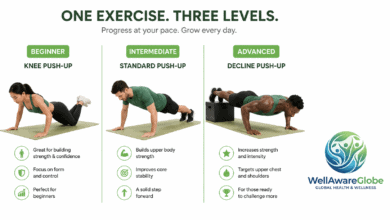
The push-up is the foundation of upper body bodyweight resistance training. It works your chest, front shoulders, and triceps simultaneously while also building core stability. But the standard push-up is just the starting point. As you get stronger, you move toward archer push-ups, decline push-ups, and eventually the full planche, which requires extraordinary shoulder strength.
Progression path: knee push-up, standard push-up, diamond push-up, archer push-up, pike push-up, pseudo planche push-up.
2. Pull-up and chin-up
If there is one exercise that defines upper body pulling strength, it is the pull-up. It targets the lats, biceps, rear deltoids, and all the muscles of your upper back. Many beginners find pull-ups difficult at first, which is perfectly normal. Start with dead hangs to build grip strength, then use assisted variations using a resistance band or jumping pull-ups until you develop enough strength to complete full reps.
Progression path: dead hang, jumping pull-up, band-assisted pull-up, chin-up, pull-up, wide-grip pull-up, archer pull-up, L-sit pull-up.
3. Bodyweight squat and pistol squat
For building lower body strength without a barbell, the pistol squat is unmatched. It is a single-leg squat that requires not just leg strength but balance, flexibility, and total-body control. Getting to a solid pistol squat takes time, but the journey itself builds extraordinary functional strength in your quads, hamstrings, and glutes.
Progression path: bodyweight squat, split squat, Bulgarian split squat, assisted pistol squat, pistol squat.
4. Dip
Dips are one of the most effective pushing exercises for building the chest and triceps. You can use parallel bars, the edge of two sturdy chairs, or gymnastic rings. Ring dips add an instability element that forces your stabilizer muscles to work harder, making them significantly more challenging than bar dips.
5. Pike push-up and handstand push-up
Want boulder shoulders without any equipment? The handstand push-up is your answer. It places almost all of your body weight directly on your shoulders, making it one of the hardest pressing movements in calisthenics for strength. The pike push-up is the gateway exercise that develops the necessary shoulder strength and balance.
Progression path: pike push-up, elevated pike push-up, wall-supported handstand push-up, strict handstand push-up.
6. Glute bridge and hip thrust
The posterior chain, which includes your glutes, hamstrings, and lower back, is often underdeveloped in people who only focus on squats and push-ups. The glute bridge and single-leg hip thrust directly address this by isolating and loading the glutes through a full range of motion. Strong glutes improve posture, protect the lower back, and power almost every athletic movement.
7. Plank and hollow body hold
Core strength is the foundation beneath everything else. Without a strong core, your push-ups will sag, your squats will fold, and your pull-ups will be inefficient. The plank and hollow body hold train your core to resist extension and rotation, which is exactly what it must do in every other exercise. These are not just conditioning exercises. They are fundamental strength builders.
Progressive overload: the secret that makes it all work
Progressive overload is the single most important principle in any strength training program, including home workouts for muscle. It simply means making your workouts harder over time so your muscles are always challenged and forced to adapt.
With weights, progressive overload is easy. You add more weight to the bar. With bodyweight training, you have several other options.
- Move to a harder exercise variation (as shown in the progressions above)
- Add more reps or sets to your current exercise
- Slow down the tempo, especially the lowering phase
- Reduce rest time between sets
- Add a pause at the hardest part of the movement
- Train one limb at a time to double the load per limb
The principle of keeping a training log matters here. If you are not tracking your reps, sets, and exercise variations, you cannot confirm that you are progressing. Write it down or use a simple app to monitor your improvements week by week.
A complete weekly plan using bodyweight exercises for strength building
A well-structured weekly plan ensures that you train all muscle groups, allow enough recovery, and stay consistent. The following plan uses a push-pull-legs split, which is one of the most proven structures for building strength and muscle over time.

Day 1: Push (chest, shoulders, triceps)
- Push-up variation: 4 sets of max reps
- Dip: 3 sets of 8 reps
- Pike push-up: 3 sets of 10 reps
- Diamond push-up: 3 sets of 8 reps
- Hollow body hold: 3 sets of 30 seconds
Day 2: Pull (back, biceps, rear deltoids)
- Pull-up or chin-up: 4 sets of max reps
- Inverted row (using a table or low bar): 3 sets of 10 reps
- Archer pull-up: 2 sets of 4 reps per side
- Face pull substitute (band pull-aparts if available): 3 sets of 15 reps
- Dead hang: 3 sets of 30 seconds
Day 3: Legs and core
- Squat progression: 4 sets of 10 reps
- Split squat: 3 sets of 10 reps per leg
- Glute bridge or single-leg hip thrust: 3 sets of 12 reps
- Calf raise (single leg): 3 sets of 15 reps
- Plank: 3 sets of 45 seconds
- Hollow body hold: 3 sets of 20 to 30 seconds
Day 4: Rest or active recovery
Light walking, stretching, or mobility work. Recovery is where strength actually gets built. Do not skip rest days.
Days 5 and 6: Repeat push and pull
Repeat the push and pull sessions with the goal of either adding one more rep per set or moving slightly closer to a harder variation than you were earlier in the week.
Day 7: Rest
Recovery and sleep guide for strength athletes
Common mistakes that slow your strength gains
Even with the right exercises, several very common errors prevent people from making the progress they want. Avoiding these will accelerate your results significantly.
Skipping the harder variations too soon
Many people stick to the same push-up or squat variation for months because it feels comfortable. Comfort is the enemy of progress. If you can do more than 15 reps of a movement with good form, it is time to move to the next progression. The goal is to keep your muscles under genuine challenge.
Ignoring pulling movements
Push-ups and squats dominate most home workout for muscle plans, but pulling movements like pull-ups and rows are equally important. Neglecting the back leads to muscle imbalances, poor posture, and shoulder problems over time.
Poor range of motion
A half-rep push-up gives you half the benefit. Full range of motion increases muscle activation, builds flexibility, and reduces injury risk. Go all the way down and all the way up on every single rep, every single time.
Not eating enough protein
Training is only half the equation. Your muscles need protein to repair and grow. Aim for at least 0.7 grams of protein per pound of body weight per day. Good sources include eggs, chicken, fish, lentils, Greek yogurt, and cottage cheese.
No recovery time
Training every day without rest does not build strength faster. It breaks the body down faster. Muscles grow during recovery, not during the workout itself. At least one full rest day between training sessions for each muscle group is essential.
Nutrition basics to support your bodyweight resistance training
Does not mean you need to be obsessive about food, but some basic habits will dramatically improve your strength gains.
Protein is the building block of muscle. Carbohydrates fuel your workouts and replenish glycogen stores. Healthy fats support hormone production, including testosterone, which plays a direct role in muscle building. Eating enough total calories is also critical. Many people who struggle to build strength are simply not eating enough.
A simple approach: eat lean protein with every meal, include vegetables and whole grains, stay hydrated, and avoid highly processed foods most of the time. You do not need a complicated meal plan to make this work.
Equipment that can take your training further
Pure bodyweight training requires nothing, but a few low-cost tools can open up significantly more exercise options and help you progress faster.
- A pull-up bar (doorframe or wall-mounted) unlocks the entire pulling movement pattern
- Gymnastic rings add instability and dramatically increase difficulty for push-ups, dips, and rows
- Resistance bands help with assisted pull-ups and can add resistance to push-ups and squats
- Parallettes allow you to do L-sits, dips, and pike push-ups with greater range of motion
- A jump rope adds excellent cardiovascular conditioning and foot speed work
How long does it take to see results
This is the question everyone asks, and it deserves a straightforward answer. Most people start noticing strength improvements within two to four weeks of consistent training. Visible muscle changes typically take six to eight weeks. Significant transformation takes three to six months of regular effort.
The pace depends on several factors including your starting fitness level, how well you eat and sleep, training consistency, and how aggressively you progress through exercise variations. People who are brand new to exercise tend to see the fastest early results because of neurological adaptations. Experienced athletes see slower but still meaningful gains.
The most important thing is not to compare your timeline to anyone else. Progress is individual. Track your own numbers, celebrate small wins, and trust the process.
Inconclusion of Bodyweight Exercises
Bodyweight exercises for strength building are not a consolation prize for people who cannot afford a gym. They are a legitimate, science-backed, endlessly scalable method of building muscle, strength, and athletic performance using nothing more than your own body.
By mastering the key movements, applying progressive overload consistently, eating to support recovery, and following a structured weekly plan, you can achieve a level of strength that surprises even experienced gym-goers. The path is clear. The tools are already with you. All that remains is to start.
Ready to begin? Start with the beginner progressions above three times this week. Write down your reps. Come back next week and try to beat them. That is how real strength is built.
Frequently asked questions
Can bodyweight exercises really build as much muscle as lifting weights?
Yes, with proper progressive overload. Research shows that calisthenics and resistance training produce similar strength and hypertrophy outcomes when volume and intensity are matched. The key is consistently making the exercises harder as you improve, just as you would add weight to a barbell.
How many days a week should I train with bodyweight exercises?
Three to five days per week is the ideal range for most people. A push-pull-legs split across four days allows each muscle group to recover fully before being trained again, which is the optimal frequency for strength and muscle growth.
What is the hardest bodyweight exercise for strength?
The planche and its progressions are widely considered the most demanding upper body strength movements in calisthenics. The planche requires you to hold your entire body parallel to the ground supported only by your hands, demanding extraordinary shoulder, tricep, and core strength that takes most athletes years of training to achieve.
Do I need a pull-up bar for bodyweight strength training?
Not strictly, but it is strongly recommended. Without any pulling apparatus, you can only work the pushing and lower body patterns, leading to imbalances. An inexpensive doorframe pull-up bar costs less than a single gym session and opens up the entire back and bicep training spectrum.
Is bodyweight training good for weight loss as well as strength?
Absolutely. Building muscle through bodyweight resistance training increases your resting metabolic rate, meaning you burn more calories throughout the day even while at rest. Combined with a slight calorie deficit and adequate protein, bodyweight training is an excellent tool for simultaneous fat loss and muscle retention.




Leave a Reply