Home Workout Routine for Beginners: The Complete Guide to Getting Fit at Home


Start your fitness journey with this complete beginner’s home workout routine. Discover easy exercises, tips, and a step-by-step plan to get fit at home.
RECOMMENDED POST: Bodyweight Exercises for Strength Building That Work
What Is a Good Home Workout Routine for Beginners?
A good home workout routine for beginners includes a mix of bodyweight exercises that target the major muscle groups, performed 3 to 4 days per week with rest days in between. The best beginner routine combines movements like squats, push-ups, lunges, planks, and glute bridges into short sessions of 20 to 30 minutes. No gym membership or equipment is required. Consistency, proper form, and gradual progression are the three factors that determine real results for anyone just starting out.
You Do Not Need a Gym to Get Fit
One of the biggest myths about fitness is that you need a gym membership, expensive equipment, or hours of free time to see real results. The truth is that some of the most effective training you can do happens right in your living room, bedroom, or backyard.
If you are a beginner, starting at home is actually a smarter move than walking into a gym cold. You can move at your own pace, avoid the intimidation factor that comes with crowded workout floors, and build a solid fitness foundation before ever setting foot in a commercial gym if that is even something you want.
This guide gives you everything you need: a science-backed explanation of how beginner fitness works, a structured weekly workout plan, exercise instructions, recovery advice, and answers to the most common questions beginners ask. By the time you finish reading, you will have a clear roadmap to follow starting today.
Why Home Workouts Work for Beginners
Home workouts are not a compromise. For beginners, they are often the ideal starting point. Here is why they work so well at this stage of your fitness journey.
Lower Barrier to Entry
You do not need to commute, pack a gym bag, wait for equipment, or pay monthly fees. The moment you decide to work out, you can start. That reduction in friction is hugely important for beginners who are still trying to make exercise a consistent habit rather than an occasional event.
Bodyweight Training Builds Real Strength
Many people assume bodyweight exercises are too easy to produce real physical change. Research published in the Journal of Human Kinetics shows that progressive bodyweight training produces measurable gains in muscular strength, muscular endurance, and cardiovascular fitness, particularly in untrained individuals. Your own bodyweight provides more than enough resistance to challenge your muscles meaningfully when you are just starting out.
You Can Progress Without Equipment
Progression in home workouts does not require heavier weights. You can increase difficulty by adding repetitions, reducing rest time, slowing down the tempo of each movement, adding a pause at the hardest point, or moving to more challenging exercise variations. This principle, known as progressive overload, is the same foundation used in professional strength and conditioning programs.
The Habit Forms Faster
Behavioral research consistently shows that the easier a habit is to perform, the more reliably it sticks. When your workout requires nothing more than getting off the couch and moving, it removes the most common excuses that cause beginners to quit in the first month.
What to Know Before You Start: Beginner Fitness Basics
Understand the FITT Principle
The FITT principle is a framework used by fitness professionals to design effective training programs. FITT stands for Frequency, Intensity, Time, and Type. For beginners, a balanced starting point looks like this:
- Frequency: 3 to 4 workout sessions per week with at least one rest day between sessions.
- Intensity: Moderate. You should feel challenged but still be able to hold a short conversation during most of the workout.
- Time: 20 to 35 minutes per session. Short, focused workouts are far more effective than long, unfocused ones.
- Type: A combination of bodyweight strength exercises and light cardiovascular movement.
Warm Up Every Single Time
Skipping the warm-up is the most common mistake beginners make. A proper warm-up gradually raises your heart rate, increases blood flow to your muscles, improves joint range of motion, and prepares your nervous system for movement. This directly reduces your risk of injury and improves the quality of every rep you perform.
A simple 5-minute warm-up for beginners can include: 60 seconds of marching in place, 10 arm circles in each direction, 10 hip circles, 10 bodyweight squats at a slow tempo, and 10 leg swings on each side.
Learn to Cool Down and Stretch
Cooling down after a workout helps your heart rate return to its resting level gradually, which is especially important for cardiovascular health. Spending 5 minutes stretching your major muscle groups after each session also reduces next-day soreness and improves your long-term flexibility. Hold each stretch for 20 to 30 seconds without bouncing.
Rest Days Are Part of the Program
Muscle growth and fitness improvement do not happen during the workout itself. They happen during the recovery period that follows. Rest days are not lazy days. They are the days when your body rebuilds and adapts to the stress you placed on it. Skipping rest days, especially as a beginner, leads to overtraining, fatigue, and a higher risk of injury.
The Complete Beginner Home Workout Plan (4 Weeks)
This plan is designed specifically for people who are new to exercise or returning after a long break. It requires no equipment, fits into a busy schedule, and builds progressively over four weeks so your body adapts without burning out.
Weekly Schedule Overview
- Monday: Full Body Strength Workout A
- Tuesday: Active Rest (light walking or gentle stretching)
- Wednesday: Full Body Strength Workout B
- Thursday: Active Rest
- Friday: Full Body Strength Workout A
- Saturday: Light Cardio (20 minutes of brisk walking or low-impact movement)
- Sunday: Complete Rest
Workout A: Push and Core Focus
Perform each exercise for the listed number of sets and repetitions. Rest 60 seconds between sets. Focus on controlled form rather than speed.
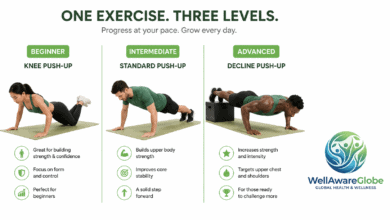
- Push-Ups (or Knee Push-Ups for beginners): 3 sets of 8 to 10 reps
- Bodyweight Squats: 3 sets of 12 reps
- Plank Hold: 3 sets of 20 to 30 seconds
- Tricep Dips (using a chair): 3 sets of 8 reps
- Superman Hold (back extension): 3 sets of 10 reps
- Dead Bug (core stabilization): 3 sets of 8 reps per side
Workout B: Pull and Lower Body Focus
- Glute Bridges: 3 sets of 15 reps
- Reverse Lunges: 3 sets of 10 reps per leg
- Wall Sit: 3 sets of 20 to 30 seconds
- Doorframe Row (using a towel around a door handle): 3 sets of 10 reps
- Bird Dog: 3 sets of 8 reps per side
- Calf Raises: 3 sets of 15 reps
How to Progress Each Week
- Week 1: Focus purely on learning the movement patterns. Use the lower end of the rep ranges. Rest fully between sets.
- Week 2: Aim for the higher end of each rep range. Reduce rest time by 10 seconds per set if movements feel manageable.
- Week 3: Add one extra set to each exercise or slow down the lowering phase of each movement to 3 seconds.
- Week 4: Attempt more challenging variations where possible. Try standard push-ups if you started with knee push-ups. Try single-leg glute bridges instead of double-leg.
Exercise Technique Guide for Beginners
Proper technique is everything when you are starting out. Poor form does not just reduce the effectiveness of an exercise. It also creates movement patterns that lead to injury over time. Take the time to learn each exercise correctly before adding difficulty.
How to Do a Proper Bodyweight Squat
Stand with your feet shoulder-width apart and your toes pointing slightly outward. Push your hips back as if sitting into a chair behind you. Keep your chest tall and your knees tracking in line with your toes throughout the movement. Lower until your thighs are parallel to the floor or as deep as is comfortable for your current mobility level. Drive through your heels to return to standing.
How to Do a Proper Push-Up
Start in a high plank position with your hands placed slightly wider than shoulder-width. Your body should form a straight line from your heels to the top of your head. Lower your chest toward the floor by bending your elbows at roughly a 45-degree angle from your torso. Press back up to the starting position without letting your hips sag or rise. If this is too difficult, perform the movement from your knees until you build enough upper body strength for the full version.
How to Do a Glute Bridge
Lie on your back with your knees bent and your feet flat on the floor, placed about hip-width apart. Press your feet into the ground and lift your hips toward the ceiling by squeezing your glutes at the top. Your body should form a straight line from your shoulders to your knees at the peak of the movement. Hold for one second, then lower your hips back down with control. Avoid using your lower back to drive the movement. The work should come from your glutes and hamstrings.
How to Hold a Plank
Place your forearms flat on the floor with your elbows directly below your shoulders. Extend your legs behind you and support yourself on your toes. Your body should form a straight line from head to heels. Engage your core by drawing your belly button toward your spine, and squeeze your glutes to prevent your hips from dropping. Breathe steadily throughout the hold and avoid holding your breath.
Building the Habit: How to Stay Consistent as a Beginner
The hardest part of any beginner workout program is not the exercises themselves. It is showing up consistently, especially in the first few weeks before results are visible and before the habit feels automatic. Here are practical strategies that help beginners stay on track.
Start Smaller Than You Think You Need To
Most beginners overestimate what they should do in week one. They start with five workouts, an hour each session, and a complete diet overhaul simultaneously. By week two, they are exhausted and have quit. A much better approach is to start with two or three short sessions per week and build from there. Success in the early weeks builds the confidence and momentum that carries you forward.
Schedule Your Workouts Like Appointments
Decide in advance which days and what time you will work out, and treat those time slots the same way you would treat a doctor’s appointment or an important meeting. Leaving it to chance each day means it rarely happens, especially when life gets busy.
Track Your Progress
Keep a simple workout log, either in a notebook or a free app, where you record the exercises you completed, how many reps and sets you did, and how you felt. Tracking progress gives you visible evidence that you are improving, which is one of the most powerful motivators to keep going. Over weeks, you will look back and see that you can do things now that felt impossible at the start.
Find an Accountability Partner
Research from the American Society of Training and Development shows that people who commit to a specific goal with another person have a significantly higher chance of completing it. Tell a friend or family member about your workout plan, or join an online fitness community where beginners share their progress.
Focus on How You Feel, Not Just How You Look
Physical appearance changes take time, often 8 to 12 weeks before they become clearly visible. But improvements in energy levels, sleep quality, mood, mental clarity, and daily strength happen much sooner, often within the first two to three weeks. Paying attention to these internal changes keeps you motivated during the period before the mirror starts reflecting your effort.
Common Beginner Workout Mistakes to Avoid
Skipping the Warm-Up
Going straight into exercise with cold muscles significantly increases your injury risk. Even five minutes of light movement before your session makes a real difference in both safety and performance.
Training Through Pain
There is a difference between the normal discomfort of muscle fatigue during exercise and sharp, stabbing, or joint-related pain. The first is expected and fine. The second is your body signaling that something is wrong. If you feel genuine pain during a movement, stop the exercise, assess the problem, and if necessary, consult a qualified physiotherapist or sports medicine physician before continuing.
Neglecting Recovery and Sleep
Your muscles grow during sleep, not during the workout. Adults need 7 to 9 hours of quality sleep per night for optimal physical recovery. Chronic sleep deprivation directly impairs muscle protein synthesis, increases the stress hormone cortisol, and slows progress regardless of how hard you train.
Expecting Overnight Results
Sustainable fitness is built over months, not days. Most beginners who quit do so because they expected visible changes within two weeks and felt discouraged when they did not see them. Trust the process, focus on small wins, and understand that every workout is contributing to changes happening at a cellular level even before they are visible.
Copying Advanced Workout Programs
Many beginners find a workout program used by an elite athlete or a fitness influencer and try to follow it exactly. Programs designed for advanced athletes involve training volumes and intensities that would overwhelm a beginner’s recovery capacity. Always start with a program designed specifically for your current level.
Nutrition Tips to Support Your Home Workout Routine
Exercise and nutrition work together. You can follow the best beginner workout plan in the world and still limit your results if what you eat does not support your training. Here are the most important nutrition principles for beginners to understand.
Eat Enough Protein
Protein is the building material your body uses to repair and rebuild muscle tissue after exercise. The general recommendation for people doing regular strength training is 1.6 to 2.2 grams of protein per kilogram of body weight per day, according to research reviewed by the International Society of Sports Nutrition. Good sources include eggs, chicken, fish, Greek yogurt, lentils, and cottage cheese.
Do Not Under-Eat
Many beginners try to combine a new workout program with aggressive calorie restriction. This approach slows progress significantly because your body needs adequate energy to fuel workouts and to rebuild muscle afterward. Unless you are working with a registered dietitian or physician, avoid going below your maintenance calorie needs by more than a modest deficit.
Hydrate Before, During, and After Exercise
Dehydration reduces physical performance, increases perceived effort, and slows recovery. Drink water consistently throughout the day, and aim to consume at least 500ml of water in the two hours before your workout. If your sessions are longer than 45 minutes or you are sweating heavily, consider a drink with electrolytes to replace what is lost.
Time Your Meals Sensibly
You do not need to eat immediately before working out, but you also should not train on a completely empty stomach if your session is intense. A light, easily digestible meal or snack containing carbohydrates and a small amount of protein about 60 to 90 minutes before exercise gives your body the fuel it needs to perform well.
Frequently Asked Questions About Home Workout Routines for Beginners
How many days a week should a beginner work out at home?
Beginners should aim for 3 to 4 workout days per week, with at least one rest or active recovery day between each session. This frequency gives your muscles enough stimulus to adapt and grow while also providing the recovery time they need. More is not better when you are just starting out. Quality and consistency matter far more than volume in the early weeks.
Can I build muscle with just bodyweight exercises at home?
Yes, absolutely. Bodyweight exercises create the mechanical tension and metabolic stress that trigger muscle growth, the same way weighted exercises do, provided you apply the principle of progressive overload over time. Push-ups, squats, lunges, dips, and pull-ups have been used to build functionally strong and muscular physiques for decades without any gym equipment.
How long should a beginner home workout be?
For beginners, workout sessions of 20 to 35 minutes are ideal. This duration is long enough to generate a meaningful training stimulus but short enough to be manageable and sustainable. As your fitness level improves over weeks and months, you can gradually extend session length or increase density by doing more work in the same time frame.
What is the best time of day to work out at home?
The best time to work out is the time that you will actually do it consistently. Research shows that the physiological differences between morning, afternoon, and evening training are minimal for general fitness goals. Afternoon and early evening workouts tend to coincide with peak body temperature and reaction time, which can slightly improve performance. But if morning is the only window that works with your schedule, morning workouts are equally effective when done consistently.
Do I need any equipment to start a home workout routine?
No. A complete and highly effective beginner workout routine requires nothing more than your own bodyweight and a small amount of floor space. Once you have been training consistently for 8 to 12 weeks and bodyweight movements start to feel too easy, you might consider adding a set of resistance bands or a pair of light dumbbells to increase training variety and resistance. But these are upgrades, not requirements from the start.
How soon will I see results from a home workout routine?
Most beginners notice improvements in energy, mood, and overall physical endurance within the first two to three weeks. Visible changes in muscle tone and body composition typically become apparent between 6 and 12 weeks of consistent training, depending on nutrition, sleep quality, starting fitness level, and how well the progressive overload principle is applied throughout the program.
Is it safe to work out every day as a beginner?
Daily vigorous exercise is not recommended for beginners. Your muscles and connective tissues need time to recover and rebuild after each training session. Training every day without adequate rest dramatically increases injury risk and leads to overtraining syndrome, which causes fatigue, declining performance, and prolonged recovery. Stick to 3 to 4 training days per week and use the remaining days for rest or light activity like walking or stretching.
Further Reading
- Centers for Disease Control and Prevention: Physical Activity Guidelines for Adults
- American College of Sports Medicine: Physical Activity Guidelines
- Mayo Clinic: Fitness Basics for Beginners
- National Academy of Sports Medicine: Beginner’s Guide to Exercise
- Harvard Health Publishing: Exercise and Fitness
- World Health Organization: Physical Activity Fact Sheet
Backlink and Content Strategy Notes
Recommended Internal Linking Targets
- Link to related articles such as “Best Bodyweight Exercises for Beginners,” “How to Lose Weight at Home Without Equipment,” and “Beginner Nutrition Guide for Fitness.”
- Link to any exercise demonstration pages or video content on your site from the technique section.
- Link to a “fitness glossary” or “workout terms explained” page if one exists on your site.
Recommended Guest Post and Backlink Outreach Targets
- Health and wellness blogs with a Domain Authority of 40 or higher that publish fitness beginner content.
- Personal finance and lifestyle blogs that cover home-based cost saving activities including home fitness.
- Parenting and family lifestyle blogs where home workout content is relevant to busy parents.
- Corporate wellness and HR blogs that address employee physical health and remote work fitness habits.
- Fitness platforms such as Healthline, Verywell Fit, and Greatist that accept expert contributor content.
Conclusion: The Best Home Workout Is the One You Actually Do
Starting a home workout routine as a beginner does not need to be complicated. You do not need a perfectly designed program, expensive equipment, or two hours of free time each day. What you need is a basic structure, a commitment to showing up consistently, and the patience to let progress build over time.
The plan laid out in this guide gives you a real, workable starting point. Three to four sessions a week, 20 to 35 minutes each, using nothing but your own bodyweight. That is genuinely enough to transform your fitness level over the course of a few months if you apply it consistently.
Start where you are. Use what you have. Do not wait for the perfect moment because it will not come. The best workout you can do today is the one you actually start.
As your fitness improves and the movements in this plan begin to feel easy, revisit the progression guidelines in this article and continue raising the challenge. Fitness is a long game, and every session you complete brings you further along the path.
If you have any pre-existing medical conditions, injuries, or health concerns, please consult your doctor or a qualified fitness professional before beginning a new exercise program.