Discover simple home exercises to improve strength and energy. No gym needed. Start building a stronger, more energetic body today with these proven moves.
Have you ever felt too tired to exercise but somehow also too tired because you are not exercising? That loop is more common than you think. Millions of people want to feel stronger and more energetic every day, but between work, family, and everything else life throws at you, getting to a gym feels like climbing a mountain before the workout even starts.
Here is the good news. You do not need a gym membership, expensive equipment, or two-hour workout blocks to make a real difference in how you feel. Simple home exercises to improve strength and energy are some of the most effective tools available, and they fit into even the busiest schedules.
RECOMMENDED POST: Bodyweight Exercises for Strength Building That Work
In this article, you will learn which exercises deliver the most value, how to build a sustainable routine, what the science says about movement and energy, and exactly how to get started today without overwhelm. Whether you are a complete beginner or someone looking to get back on track, this guide is built for you.
Why Simple Home Exercises to Improve Strength and Energy Actually Work
There is a persistent myth that only heavy gym equipment, complex training programs, or professional coaching can produce real results. Science disagrees completely. Research published in the Journal of Strength and Conditioning Research has consistently shown that bodyweight training, when done with proper structure and consistency, builds genuine muscular strength, improves cardiovascular health, and enhances daily energy levels.
When you perform simple home exercises to improve strength and energy, your body adapts by increasing muscle fiber recruitment, improving neuromuscular coordination, and releasing a cascade of hormones and chemicals, including endorphins, that directly fight fatigue. The more consistently you move, the better your body becomes at producing and sustaining energy throughout the day.
Think about it this way. Your body is designed to move. When it does not get regular movement, everything from your circulation to your mitochondria (the energy factories inside your cells) becomes less efficient. Exercise is not just about looking fit. It is about restoring your body to its natural, high-functioning state.
The Core Benefits You Can Realistically Expect
When you commit to a consistent home workout routine, even just three to four sessions per week, here is what research suggests you may start to notice within the first few weeks:
- Improved physical stamina so that everyday activities like climbing stairs or carrying groceries feel easier
- Better quality sleep, which in turn leads to higher energy levels during waking hours
- Reduced feelings of stress and mental fatigue thanks to endorphin release during exercise
- Gradual gains in muscle tone and functional strength that carry over into daily life
- More consistent energy levels throughout the day rather than afternoon crashes
These are not overnight miracles. They are the natural results of giving your body what it was built to do. And the beautiful part is that none of this requires leaving your home.
The Best Bodyweight Exercises for Strength and Energy at Home
Not all exercises are created equal when it comes to building both strength and energy at the same time. The most effective moves are those that engage multiple muscle groups simultaneously, get your heart rate up slightly, and require nothing more than your own body weight and a small patch of floor space.
These are the foundational simple home exercises to improve strength and energy that fitness professionals, physical therapists, and exercise scientists consistently recommend. They are accessible to beginners yet challenging enough to keep pushing you forward as you grow stronger.
1. Squats
The squat is arguably the king of all bodyweight movements. It activates your quadriceps, hamstrings, glutes, core, and even your calves in one single movement. Because it recruits so many large muscle groups at once, squats also trigger a meaningful metabolic response, which means your body produces more energy-supporting hormones as a result.
To perform a basic squat, stand with feet shoulder-width apart, toes pointed slightly outward. Keeping your chest tall and your core braced, lower your hips back and down as if sitting into a chair. Aim to bring your thighs parallel to the floor, then press through your heels to stand back up. Start with two sets of 10 to 15 repetitions.
2. Push-Ups
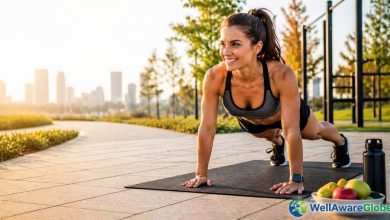
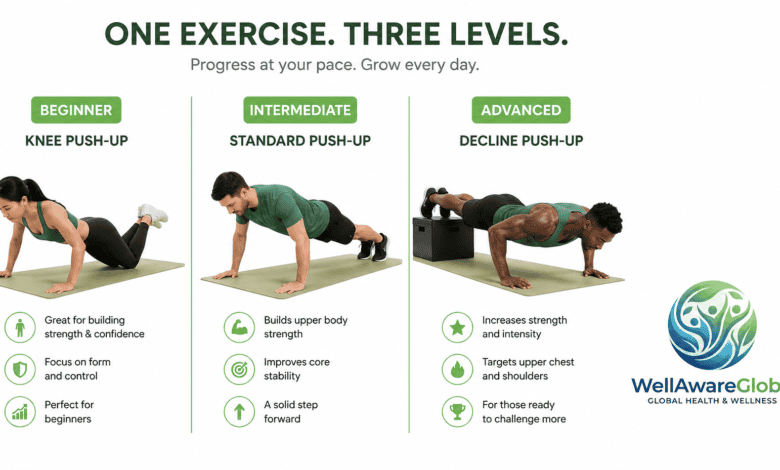
Push-ups are one of the most complete upper body exercises you can do at home. They work the chest, shoulders, triceps, and core all at once. For beginners, starting with knee push-ups or incline push-ups against a wall is a perfectly valid and effective approach. Over time, standard push-ups and their progressions will build impressive upper body strength.
The important thing with push-ups is maintaining proper form: keep your body in a straight line from head to heels, do not let your hips sag or rise too high, and lower your chest to within an inch of the floor before pressing back up. Quality always beats quantity here.
3. Glute Bridges
The glute bridge is a powerhouse move for the posterior chain, meaning your glutes, hamstrings, and lower back. This is particularly important for people who spend a lot of time sitting, as prolonged sitting tends to cause glute weakness and lower back tension. A strong posterior chain supports better posture and reduces fatigue throughout the day.
Lie on your back with your knees bent and feet flat on the floor. Press through your heels and squeeze your glutes to lift your hips toward the ceiling until your body forms a straight line from shoulders to knees. Hold for a second at the top, then lower down slowly. Two to three sets of 12 to 15 reps is a great starting point.
4. Plank
The plank is the gold standard for core stability training. A strong core is not just about having flat abs. It is the foundation of every movement your body makes. Core strength improves your balance, protects your spine, and allows your arms and legs to work more efficiently, all of which contributes to higher energy and reduced fatigue during physical tasks.
Start in a forearm plank position, elbows directly under your shoulders, body in a straight line. Hold for 20 to 30 seconds, focusing on breathing steadily and not letting your hips drop. Build up your hold time gradually over weeks. Even 60 to 90 seconds of total plank time per day can yield meaningful core improvements.
5. Walking Lunges
Lunges challenge your balance, strengthen your legs, and work each side of your body independently, which helps correct muscular imbalances that develop over time. Walking lunges in particular add a dynamic element that gets your heart rate moving and boosts calorie burn compared to static lunges.
Step forward with one foot, lowering your back knee toward the floor until both knees are at roughly 90-degree angles. Push through your front heel to bring yourself to standing, then repeat on the other side. If space is limited, stationary lunges or reverse lunges work equally well.
How to Build Your Home Workout Routine for Beginners
Knowing individual exercises is one thing. Knowing how to put them together into a home workout routine for beginners is where most people need the most help. Without a structure, workouts become inconsistent, and inconsistency is the number one reason people stop seeing results and give up.
The good news is that building an effective home routine does not require complicated programming. In fact, simpler is often better, especially when you are starting out. Here is a beginner-friendly framework that incorporates simple home exercises to improve strength and energy in a balanced and sustainable way.
A Simple Weekly Structure That Works
Aim to work out three to four days per week with at least one rest day between sessions. This allows your muscles to recover and grow stronger. Here is an example of how to structure your week:
- Day 1 (Monday): Full body circuit with squats, push-ups, and plank
- Day 2 (Tuesday): Active rest, gentle walking for 20 to 30 minutes
- Day 3 (Wednesday): Full body circuit with glute bridges, lunges, and plank
- Day 4 (Thursday): Active rest or light stretching
- Day 5 (Friday): Full body circuit, slightly increasing reps or time from Day 1
- Day 6 (Saturday): Optional light activity like yoga or a longer walk
- Day 7 (Sunday): Complete rest and recovery
How Long Should Your Workouts Be?
For beginners, aim for 20 to 30 minutes per session. That is genuinely enough. Research from the American College of Sports Medicine confirms that even short-duration resistance training sessions, when done consistently, produce measurable improvements in strength and cardiovascular fitness within six to eight weeks. As you build your fitness base, you can extend sessions to 40 or 45 minutes if you choose.
One key principle to follow: always include a brief five-minute warm-up of light movement like arm circles, leg swings, and a slow march in place. This prepares your joints and muscles for exercise and significantly reduces the risk of injury. Similarly, end with two to three minutes of gentle stretching to help your body transition back to rest.
How to Boost Energy Naturally With Exercise: What the Science Shows
You might wonder how exercising, which physically tires you out, actually helps you feel more energetic. It seems like a contradiction, but the science behind it is well-established and genuinely fascinating. Understanding this connection can help you stay motivated, especially on those days when getting started feels hard.
When you perform physical activity, your body increases the efficiency of your mitochondria, the tiny energy-producing structures inside nearly every cell. More efficient mitochondria means your body produces more ATP (adenosine triphosphate), which is the actual currency your body uses for energy. Over time, regular exercise literally increases your body’s energy-producing capacity at the cellular level.
Exercise also improves the efficiency of your cardiovascular system. Your heart gets better at pumping blood, your lungs get better at exchanging oxygen, and your blood vessels become more responsive. All of these adaptations mean that everyday activities require less effort and leave you with more energy in reserve.
The Mood and Mental Energy Connection
Physical energy is only part of the picture. Mental fatigue is often what drags people down the most. This is where exercise offers some of its most powerful benefits. Movement triggers the release of brain-derived neurotrophic factor (BDNF), often called “Miracle-Gro for the brain,” which supports memory, focus, and mental clarity.
A 2023 review in the journal Frontiers in Psychiatry found that regular moderate exercise was associated with significant reductions in symptoms of fatigue, anxiety, and low mood across multiple population groups. These are not marginal effects. For many people, consistent movement is one of the most powerful natural mood and energy regulators available.
The takeaway here is straightforward. If you want to know how to boost energy naturally with exercise, the answer is not one dramatic workout. It is consistent, moderate movement done regularly over time. That is what changes your baseline energy level.
What About Sleep and Recovery?
Exercise and sleep are deeply intertwined. Regular physical activity has been shown in multiple studies to improve sleep quality, increase time spent in deep sleep stages, and reduce the time it takes to fall asleep. Since deep sleep is when your body repairs muscle tissue and consolidates energy, better sleep directly translates to higher energy the next day. This creates a positive cycle: exercise improves sleep, better sleep improves your energy and performance during exercise, and that cycle reinforces itself over time.
No-Equipment Fitness Exercises for Every Fitness Level
One of the biggest barriers people cite when it comes to working out at home is the belief that you need equipment to get a real workout. This is simply not accurate. No-equipment fitness exercises have been the foundation of human physical conditioning for thousands of years, and they remain highly effective today.
Below is a curated list of no-equipment fitness exercises organized by fitness level. Whether you are a complete beginner or have some training experience, there is something here to challenge and strengthen you.
Beginner Level
- Wall push-ups: Place your hands on a wall at shoulder height and perform a push-up motion. Great for building initial upper body strength with minimal joint stress.
- Seated marching: Sit on a chair and alternate lifting your knees toward your chest. Builds hip flexor strength and gets blood circulating.
- Standing calf raises: Rise onto your toes repeatedly to strengthen calves and improve ankle stability.
- Lying leg raises: Lie flat on your back and raise straight legs to 45 degrees, then lower slowly. Builds lower core strength without neck strain.
Intermediate Level
- Standard push-ups with proper form as described earlier in this article.
- Jump squats: Add a jump at the top of each squat for a cardiovascular boost and power development.
- Mountain climbers: From a push-up position, alternate driving your knees toward your chest rapidly. Excellent for core strength and cardiovascular conditioning.
- Tricep dips using the edge of a sturdy chair: Great for the back of the arms and shoulder stability.
Advanced Level
- Pike push-ups: A push-up variation that shifts emphasis to the shoulders and upper back.
- Single-leg squats (pistol squat progressions): Dramatically increases leg strength demands and challenges balance.
- Burpees: A full-body exercise combining a squat, push-up, and jump. High intensity and highly effective for conditioning.
- Superman holds: Lie face down and lift arms and legs simultaneously off the floor. Builds posterior chain strength and spinal stability.
Daily Exercise Habits That Make Strength and Energy Last
Doing a few good workouts is not the same as building lasting fitness. The real magic happens when you develop daily exercise habits, small consistent actions that compound over weeks and months into genuine transformation. This section is about the habits and mindset shifts that help your results stick.
Make Movement a Non-Negotiable Part of Your Day
The people who maintain fitness over the long term are not necessarily the most motivated. They are the ones who have made movement a default part of their routine rather than something they do when they feel inspired. Motivation comes and goes. Habit and structure stay.
Consider anchoring your workout to an existing habit. For example, do your exercises immediately after brushing your teeth in the morning, right before your first cup of coffee, or immediately after logging off from work in the evening. Behavioral science research from University College London suggests it takes an average of 66 days for a new behavior to become automatic. Be patient with yourself during that initial period.
Progressive Overload: The Key to Continued Growth
Your body adapts to the demands you place on it. Once a workout becomes easy, it stops producing the same results. This is not failure; it is progress. The solution is progressive overload, which simply means gradually increasing the challenge of your exercises over time.
Here are practical ways to apply progressive overload to simple home exercises to improve strength and energy without needing any equipment:
- Add more repetitions to each set (e.g., go from 10 to 15 squats per set)
- Reduce rest time between sets gradually
- Slow down the lowering phase of each exercise (e.g., take 3 to 4 seconds to lower into a squat)
- Progress to a harder variation (e.g., from wall push-ups to standard push-ups)
- Add an extra set per exercise over time
Nutrition and Hydration: The Unsung Supporters
Exercise alone is a powerful tool, but it works best alongside adequate nutrition and hydration. You do not need to follow a strict diet to see results, but a few simple nutritional habits can significantly amplify what your exercise routine is doing for your energy. Focus on eating enough protein to support muscle repair (roughly 0.7 to 1 gram per pound of body weight per day is a commonly cited starting point), staying well-hydrated throughout the day, and eating enough overall calories to fuel your activity.
Note: Specific nutritional needs vary significantly between individuals based on health status, goals, age, and other factors. For personalized dietary guidance, consult a registered dietitian or your healthcare provider.
Real-World Example: How a Simple Routine Changed Everything
Consider the story of someone we will call Adaeze, a 38-year-old working mother of two from Lagos who spent most of her day seated at a desk and felt perpetually drained by 3 PM. She had tried gym memberships twice but found the commute and the schedule conflict simply unsustainable. She wanted more energy but had convinced herself that serious exercise required serious infrastructure.
Adaeze started with a 20-minute bodyweight routine three mornings per week, before her children woke up. The routine was straightforward: two sets of 12 squats, two sets of wall push-ups, two sets of glute bridges, and a 30-second plank. Nothing fancy. Nothing that required equipment she did not have.
By week four, she noticed she was no longer hitting the afternoon energy wall as hard. By week eight, she had progressed to standard push-ups and was doing three sets of each exercise. By month three, colleagues were commenting on how much more alert and positive she seemed. Her back pain from sitting had also noticeably decreased.
This is not a unique story. It reflects what exercise research consistently shows: the people who benefit most from home-based strength training are not elite athletes. They are regular people with busy lives who simply decide to start small and stay consistent. The specific exercises matter less than the commitment to showing up regularly.
The most common mistake people make is waiting until they have more time, more equipment, or more motivation. None of those things arrive on their own. What does arrive, gradually and reliably, is progress, once you start.
Frequently Asked Questions
How long before I start noticing more energy from home exercises?
Most people begin to notice subtle improvements in their daily energy levels within two to four weeks of consistent exercise. Sleep quality often improves first, followed by reduced afternoon fatigue, and then more sustained energy throughout the day. Significant strength improvements typically take six to eight weeks to become clearly noticeable. The key word in all of this is consistent. Sporadic workouts produce sporadic results.
Can I do these simple home exercises to improve strength and energy every day?
For most people, three to four days per week of structured strength training is more effective than exercising every single day. Your muscles repair and grow stronger during rest, not during the workout itself. That said, light daily movement like walking, stretching, or gentle yoga is beneficial and does not require full recovery days. If you want to move every day, alternate between more intense workout days and lighter active recovery days.
Is a home workout routine effective without any equipment at all?
Absolutely. Bodyweight training is a legitimate and well-researched form of resistance training. Studies comparing bodyweight programs to gym-based resistance training programs have found comparable improvements in muscular strength, endurance, and cardiovascular fitness when training volume and progressive overload principles are applied. What matters most is not the presence of dumbbells or machines, but the consistency, effort, and progression you bring to your training.
Conclusion
Simple home exercises to improve strength and energy are not a compromise. They are a genuine, research-backed approach to building the physical and mental vitality you want. You do not need a gym, expensive equipment, or hours of free time. What you need is a clear starting point, a manageable structure, and the willingness to begin.
Throughout this article, we covered the science behind why bodyweight training works so well for energy and strength, the best foundational exercises you can do at home today, how to structure a beginner-friendly weekly routine, what the research says about exercise and energy at the cellular level, a full range of no-equipment fitness exercises from beginner to advanced, the habits and mindset shifts that make results last, and the kind of real-world progress that is realistic and achievable.
Your next step is simple. Pick two or three exercises from this article, set aside 20 minutes tomorrow morning, and do them. Do not wait for the perfect moment, the perfect routine, or the perfect motivation. The people who see results are the ones who start imperfectly and keep going anyway.
Stronger days are ahead. And they start at home.
Ready to take the first step? Bookmark this page, share it with a friend who could use more energy, and leave a comment below telling us which exercise you are going to try first. Your journey to feeling stronger and more energetic starts with one move.
Helpful Resources for Further Reading
- American College of Sports Medicine (ACSM): acsm.org – Evidence-based exercise recommendations and fitness guidelines
- Centers for Disease Control and Prevention (CDC) Physical Activity Guidelines: cdc.gov/physicalactivity – Official physical activity recommendations for adults
Health Disclaimer: The information provided in this article is intended for general educational purposes only and does not constitute medical advice. Individual results from exercise vary. Always speak with a qualified healthcare professional before beginning a new fitness program, particularly if you are pregnant, recovering from injury, or managing a chronic health condition. Stop exercising and seek medical attention if you experience unusual pain, dizziness, shortness of breath, or chest discomfort during physical activity.